Paul Conroy's Dispatch Two: Jose's Tale

After several days of Atlantic storms, the coast was battered and the heat suppressed. The power had been out for an average of twenty hours a day this week. By midday, the sun returned, hard and unforgiving.
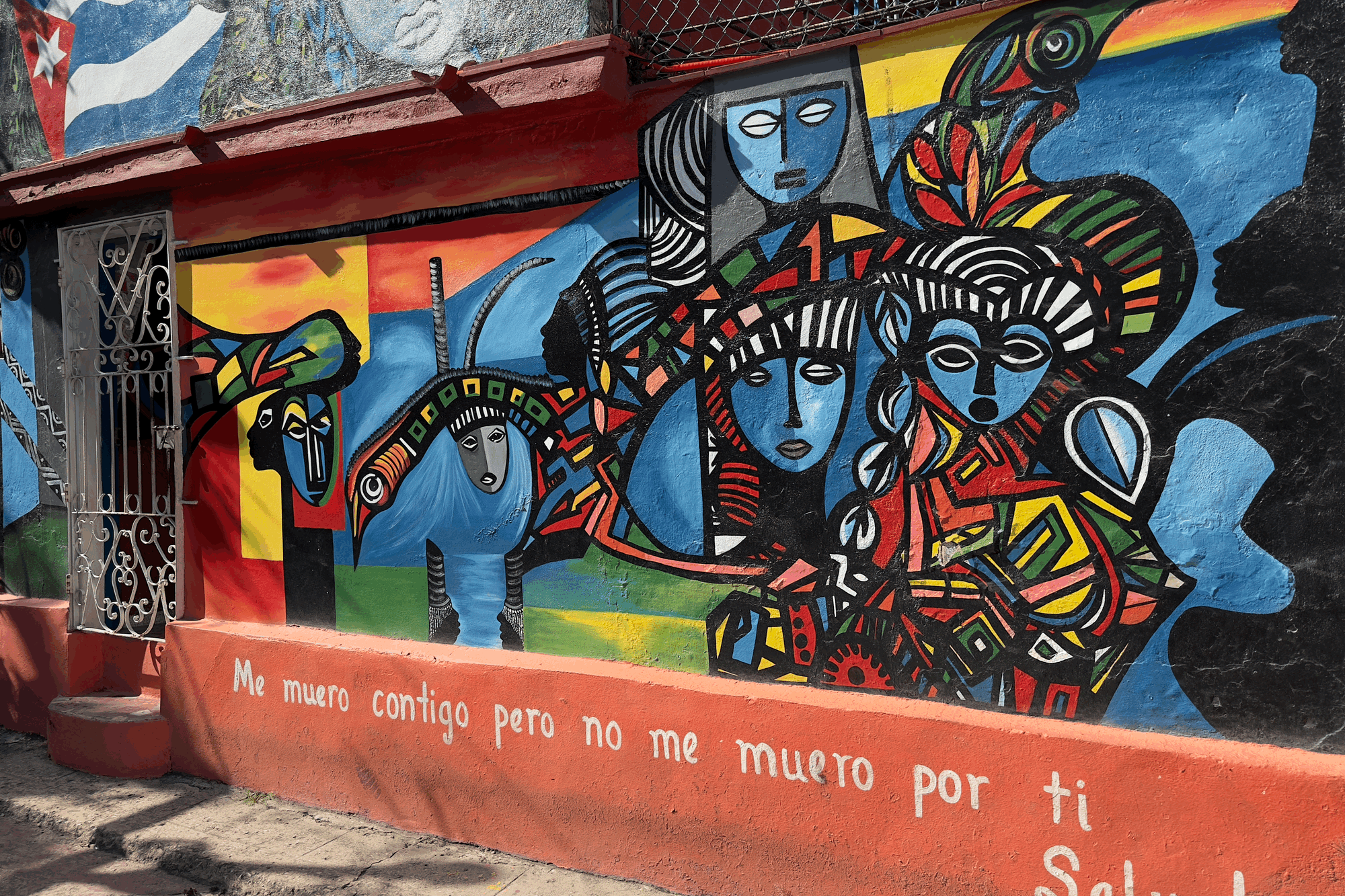
I’m sitting in the Callejón de Hamel, a narrow alley in central Havana, wedged between long-neglected neighbourhoods. It’s alive with colour. Murals cover the walls, Afro-Cuban deities, faces, symbols, painted by Salvador González Escalona. His answer to neglect was simple: put the art in the street. Give it to the people.
It’s a tourist trap now. That’s the point.
The man I’m here to meet wants it that way. José is a former political prisoner, recently released after serving five years. He told me this is the safest place. He can be seen with a foreigner here without drawing much attention.
I wait. The minutes stretch. I study the photographs of celebrities who’ve passed through the bar over the decades. The prints are faded and worn, like the place itself. The buildings here are being eaten away by Atlantic wind and sea spray.
A small, wiry man in his early sixties enters the bar. Neat shirt. Faded jeans. A face shaped by weather and time. He pauses, scans the room carefully, then spots me in the corner. A nod. He comes over and sits.
His smile is restrained but kind. When we shake hands, I feel the callouses, thick, worked-in.
“José,” he says. “Apologies for the secrecy. The CDR watches me most days.”
I don’t follow.
“The CDR,” he says. “Committees for the Defence of the Revolution.” He keeps his voice low. “They’re in every block. They note who comes and goes. Count parcels. Watch who stays the night.” A pause. “Castro set them up.”
There’s a flicker in his eyes now. Not fear. Something harder.
“You walk these streets,” he says, nodding towards the alley, “they watch you. They have eight million people on their books. They are everywhere.”
Cuba’s population is eleven million.
I ask why he was in prison. He laughs, short and bitter.
“I helped a journalist,” he says. “My father died when a balcony collapsed and crushed him. He was sleeping outside. It was too hot in the house.” He looks past me as he speaks. “We had an illegal newspaper. I talked to them.”
He pauses.
“Three weeks later they came for me. I was gone five years.”
That made his presence here, talking to me, all the more remarkable.
“We’re safe here,” he says, glancing around the bar. “They want this.” He taps the table. “Tourists. Dollars.” A pause. “Every hotel. Every American Cadillac taxi. Every fancy bar. It’s all built to pull in hard currency for the regime. They take a cut of everything.”
He looks past me, out towards the alley.
“And still,” he says, “the city is falling apart.”
“Aren’t you afraid?” I ask.
He smiles, thin and tired. “I’m not going back to prison,” he says, and pulls his jacket aside. A Russian Makarov pistol sits tucked into his waistband.
He looks at me.
“You want to see how the city really lives?”
I nod.
“Then we walk,” he says. “I’ll be your tourist guide,” a wry smile creasing his face.
He takes out a few crumpled peso notes, settles the bill, and stands.
Outside, the heat hits immediately. We walk past the murals, painted cash registers, welded sculptures made from cycle parts. A lone tourist is tailed by a dozen hopeful vendors, eyes fixed, rehearsing their pitch. The tourist moves on. The shoulders drop. The street exhales.
Fifty metres later we’re in a back street. Semi-feral cats nose through piles of uncollected rubbish. Two children burst out of a doorway, shrieking, hurling water-filled balloons at each other. José keeps walking. His eyes never settle, always moving, always checking.
We pass a plain white van. Two men are unloading boxes into what could be a butcher’s shop. José nods towards them.
“Imported meat,” he says. “The government takes a cut before it even gets here.”
We turn onto a wider road. Battered taxis belch diesel smoke as they weave around potholes. Somewhere a generator hums. The noise is constant, layered, restless.
At the next corner José stops and points. A fading sign hangs outside an anonymous office building: a black circle, a figure holding a machete and shield, the Cuban flag behind it. White letters spell out CDR.
Castro announced them in 1960, after narrowly escaping death in a Havana bomb blast. Revolutionary collective vigilance, he called it. Watch everyone. Everywhere.
Two blocks later, another sign hangs from a residential building.
We cut through a derelict outdoor market. The awnings are long gone, leaving only rusted frames. Inside the gates it’s clear the place has been repurposed. The stall frames are sealed off with scavenged wood, road signs, sheets of scrap aluminium, anything to keep the outside out.
Inside, people live.
Small, dark compartments. Baking hot. Mattresses on dirt floors. Plastic bottles. Old blankets. No doors. No privacy. There are hundreds of them.
“You know what?” José says.
I shake my head.
“They pay rent for this,” he says. “No toilets. No power. No water.” He spreads his hands. “This is what the government allows.” A pause. “Their children live in Dubai. In the UAE. And this is what we get.”
I make to take a picture, but Jose quickly stops me.
“Not here, too many eyes.”
It’s brutal. It reminds me of places I saw in the Soweto township.
“Raúl Castro is ninety-three now,” José says, glancing hopefully upward. “He can’t have long left.”
“Who comes next?” I ask.
He shrugs. “This is Cuba. Anyone who gets popular disappears.”
“Marco Rubio?” I ask, half-joking.
For the first time in an hour, he laughs. Really laughs.
“You’ve done your homework,” he says. “He’s a pig. Anyone who escaped to Miami is being rounded up by ICE and sent back. When they arrive, they get five years in prison.” He shakes his head. “He’s not Cuban. He doesn’t belong here.”
José scans the street again. Doorways. Windows. Corners. His shoulders tighten.
“I think you should go now,” he says. “We’ve talked enough.”
We shake hands behind a small kiosk selling soft drinks and snacks. He leans in.
“Be careful,” he says. “The longer you stay, the more they see you. The more they watch.” A beat. “Send your piece. Then delete it. Remove everything from your devices.”
He steps back, gives an exaggerated wave, and turns away. Seconds later, he disappears into the crowd.